
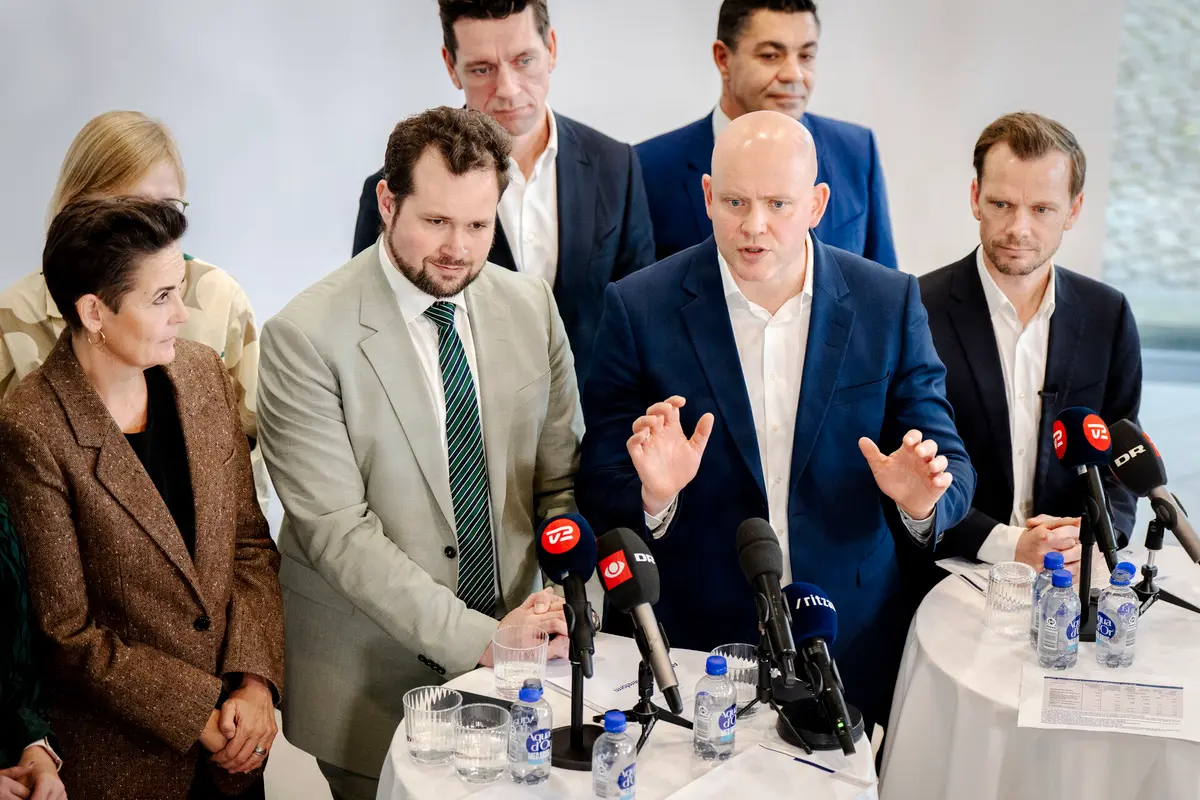
This week, the Danish government – a centre-left government made up of the Social Democrats, Moderates, the Green Left and the Social Liberals – struck a political agreement with the Danish People's Party on a new tax reform.
When I saw that headline, as someone from a country where politics is, and has arguably always been, adversarial, it made me think about how Denmark's political parties in general seem to be much more willing to collaborate across party lines and across bloc lines than parties in other countries when it comes to passing policy.
Just look at Sweden, which went to the polls two months ago but still doesn't have a government, primarily because the Left Party and Centre Party can't agree on whether or not the Left Party should be in government, despite the fact that the alternative is giving the far-right Sweden Democrats more power, which neither party wants.
Sure – it took Denmark longer than this to form a government earlier this year – but it still seems like Danish parties are much more willing to collaborate on individual policy henover midten, or across the centre, as they would say. Is Denmark one of the only countries in the world where politicians of all stripes are able to sit down and thrash out an agreement?
It didn't take long after the results of the Danish election were counted for Pelle Dragsted, leader of the Red-Green Alliance – probably the most left-wing of Denmark's left-wing parties – to say that he would be willing to collaborate with the centrist Moderates, with the shared goal of keeping the far-right Danish People's Party out of power.
I wonder if this is because Denmark has such a long tradition of minority governments (I suppose having so many parties in parliament is one of the reasons behind that), and that politicians and voters inherently understand that parties – even those on opposite sides of the political spectrum – will agree on some things and disagree on others.
To go back to this tax agreement, Pia Olsen Dhyr of the Green Left admitted after the announcement that she wasn't necessarily happy about it, as it included cutting some key left-wing policies like student grants for students living at home with a parental income over a certain level.
However, she could also see the full picture, adding that the effect of cutting these policies would be offset by other proposals in the budget.
I can't help but think that a lot of politicians elsewhere could benefit from thinking a bit more like the Danes.
In other news:
Denmark's government has, as mentioned above, struck a historic parliamentary agreement with the Danish People's Party. How much do you stand to gain or lose?
The first country to host a so-called "return hub" for migrants expelled from Europe should be revealed next week, Denmark's prime minister Mette Frederiksen said this week.
Sexual health organisation Sex og Samfund has launched a new advice programme focusing on women's health with the support of regional healthcare in Copenhagen.
Sauntering around the hippy enclave of Christiania or visiting the Dyrehaven deer park are both completely free, but an unscrupulous website has been charging tourists, warning that without a ticket they risk being fined.
Denmark's four government parties have called for evaluation of citizenship cases to be carried out by citizenship committee rather than in public, after right-wing parties went to the media with several people they believe should be denied citizenship.
Energy prices in Denmark are always higher in autumn and winter. So, what can you do on an individual level to lower your energy bills in the long run?
Copenhagen is home to some of Denmark's best-paying jobs and also some of the highest living expenses. We took a closer look at what's considered a good wage in the capital.
Unfortunately, 2027 is not a great year when it comes to public holidays or tricks for getting more time off with fewer days of annual leave. Here are our best tips for maximising your time off.
Thanks for reading,
Becky Waterton, Editor, The Local Denmark
Comments (1)